
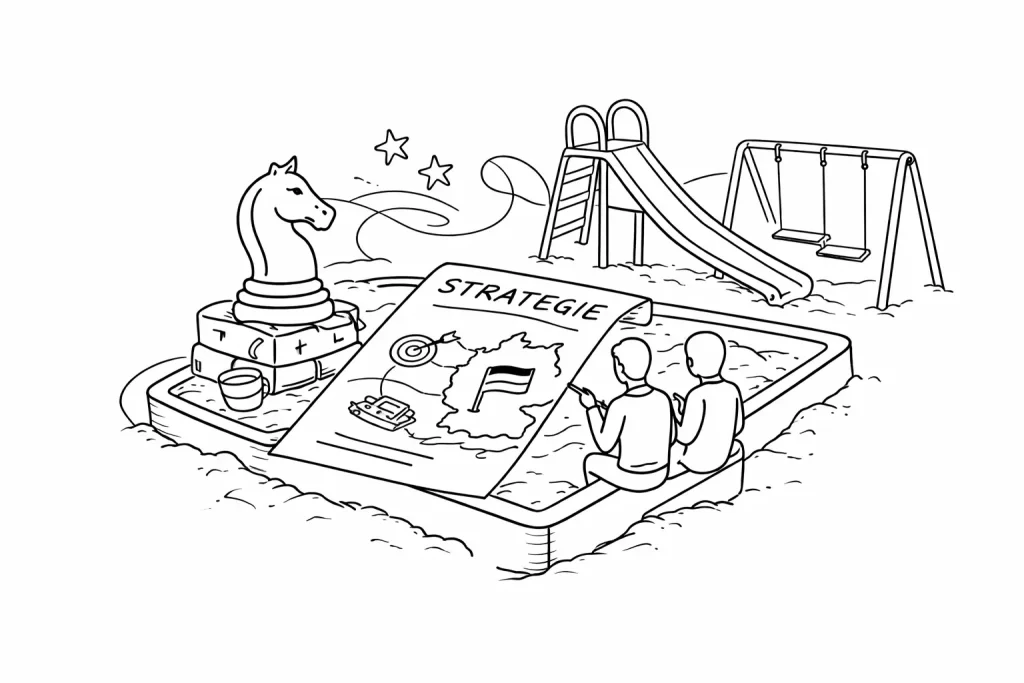
In the context of the turning point in security policy, new forms of strategic analysis are gaining importance. Wargames provide a structured approach to complex decision-making situations, make assumptions and interdependencies visible, and help to better understand strategic action under changing conditions.
Note: This is an abridged version of a forthcoming contribution by Philip Jan Schäfer and Joseph Verbovszky in the edited volume “Security Policy After the Turning Point: Challenges, Trends, and Perspectives for Germany and Europe.”
The turning point in security policy marks not only a political shift, but also a cultural space of possibility for new forms of strategic thinking in Germany. Russia’s attack on Ukraine in 2022 and the intensified debates on European autonomy have shown that the capacity for action in security policy is not solely a question of resources, structures, or institutions. It is also a matter of strategic imagination—understood as the ability to anticipate uncertainty, think through alternatives, and productively navigate trade-offs (Biehl, 2019; Giegerich & Terhalle, 2021).
In this context, wargames are gaining new significance. They are far more than military planning exercises or technical simulations. According to the Bundeswehr’s Wargaming Handbook, they are safe-to-fail environments in which at least two parties, shaped by human decision-making, interact in a conflict situation (Bundeswehr, 2023). This is precisely where their strength lies. Wargames do not generate predictions, but rather create experiential spaces of possibility. They make strategic dilemmas visible, uncover implicit assumptions, and allow courses of action to be tested under conditions of structural uncertainty (Perla & McGrady, 2011; Rubel, 2006).
Strategy is more than the rational alignment of ends, means, and ways. It is always culturally framed as well. It must be not only internally consistent, but also contextually resonant. While classical planning logics primarily rely on formal coherence, strategic thinking depends on interpretation, iteration, and sensitivity to context. Especially in a time when large language models and other AI systems are increasingly integrated into analytical processes, it becomes clear that syntactic correctness is not a sufficient response to semantic complexity. Wargames are particularly valuable in this regard because they combine formal structure with meaning-based logic. They bring actors, narratives, perceptions, and reactions together in a shared, interactive setting (NATO, 2022; Banks, 2024).
Wargames are thus not only methodological but also epistemic tools. They do not produce empirical truth in the narrow sense, but rather what Perla describes as narrative surrogate stories. These are controlled scenarios in which hypothetical decisions are made and their consequences evaluated (Perla & McGrady, 2011). Their epistemic strength therefore lies not in measurability or prediction, but in making patterns, dilemmas, and response logics visible. For this very reason, they are closer to qualitative and exploratory methods of social research than their playful surface might initially suggest (Rubel, 2006; Jensen & Banks, 2018).
This is particularly relevant for the security policy debate in Germany. German strategic culture has long been shaped by restraint, multilateralism, and a strong ethos of peace (Biehl et al., 2013). This historical imprint is understandable, but it continues to make the development of broader strategic judgment more difficult. Wargames can play a productive role here, precisely because they do not glorify war, but make uncertainty reflectable. They are not techniques of militarization, but spaces in which responsibility, legitimacy, risk, and capacity for action can be negotiated.
This becomes particularly evident in formats such as Entanglement, developed by the German Wargaming Center. Such wargames do not aim to replicate reality one-to-one. Rather, their value lies in translating complex problems into playable designs that reveal relevant dynamics and help actors focus on what is strategically decisive. In this way, wargames become spaces of cultural reflection. They test not only options, but also narratives, role conceptions, and institutional routines.
In a security environment increasingly shaped by hybrid threats, geoeconomic dependencies, and technological disruption, classical planning instruments are reaching their limits. Wargames offer a complementary approach in this regard. They make it possible to think through nonlinear dynamics, render interdependencies visible, and test strategic options under realistic conditions. Especially when dealing with issues such as geoeconomic competition, cognitive influence, or disruptive technologies, they create experiential spaces in which strategic decisions can not only be analyzed, but also practically explored.
The turning point in security policy therefore requires not only more resources or new institutions, but above all an expanded capacity for strategic thinking. Wargames make a specific contribution in this regard. They make uncertainty tangible, foster reflection, and enable collective learning under realistic conditions.
Strategic capacity for action does not begin with perfect information or fully developed plans. It begins with the ability to understand one’s own decision-making logic, question assumptions, and think through alternative courses of action. Wargames provide precisely such a structured yet open space, thereby becoming a central instrument of strategic imagination in this turning point era.
Literature
Banks, D. E. (2024). The methodological machinery of wargaming. International Studies Review, 26(1). https://doi.org/10.1093/isr/viae002
Biehl, H. (2019). Sicherheits und Verteidigungspolitik in Deutschland. Zeitschrift für Außen und Sicherheitspolitik, 12(1), 11–24.
Biehl, H., Giegerich, B., & Jonas, A. (Hrsg.). (2013). Strategische Kulturen in Europa. Springer VS.
Bundeswehr. (2023). Wargaming Handbuch.
Giegerich, B., & Terhalle, M. (2021). Zeitenwende in der Sicherheitspolitik. Zeitschrift für Außen und Sicherheitspolitik, 14(4), 487–504.
Jensen, B. M., & Banks, D. E. (2018). Wargaming and the scientific method. Naval War College Review, 71(3).
NATO. (2022). Allied joint doctrine for the conduct of operations (AJP 01).
Perla, P., & McGrady, E. (2011). Why wargaming works. Naval War College Review, 64(3), 111–130.
Rubel, R. (2006). The epistemology of wargames. Naval War College Review, 59(2), 108–128.