
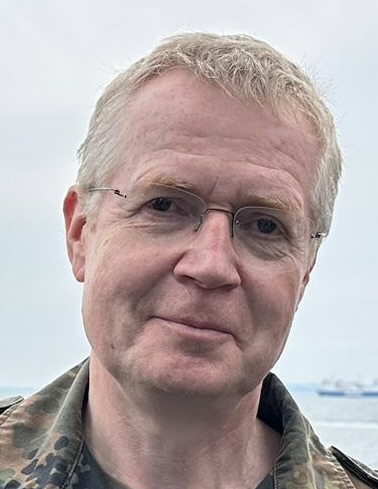
Hans-Jörg Detlefsen, born in 1963 in Böel (Schleswig-Holstein), is a retired Rear Admiral in the German Navy and, in his last assignment, Head of Group 23 in the Federal Chancellery.
As an experienced naval aviator commander and former Commander Maritime Air of NATO (MARCOM), with almost 20 years of leadership in the Ministry of Defence, the EU/NATO, and the Federal Chancellery, he possesses deep expertise in defence policy and international alliance politics. He was instrumental in the transformation of the Federal Security Council into the National Security Council and, as the architect of the new staff unit, shaped the operational transition phase of this central hub for Germany’s security.
After joining the Bundeswehr in 1983 and training as a naval aviator (Tornado), he held numerous leadership and staff positions.
From 2019 to 2022, he served as Commander Maritime Air at the Allied Maritime Command (MARCOM) of NATO in Northwood (UK), where he led all maritime air forces of the Alliance, including during Russia’s invasion of Ukraine in February 2022, ensuring the security of NATO’s eastern border at sea.
Detlefsen is regarded as one of the architects of the security policy “Zeitenwende” at the Chancellery. Between 2017 and 2026, he served three federal chancellors and four national security advisers. Detlefsen stood for a strategic-pragmatic, whole-of-government approach that connects defence, economy, and society. Experts value him as a sober analyst and reliable bridge-builder between national and international partners.
His work also shaped German security architecture during the turning point in areas such as the protection of maritime and critical infrastructure, the integration of German contributions into NATO operations, as well as the implementation of a whole-of-government responsibility for security and defence.
His commitment to the professionalisation of wargaming is driven by his conviction that today’s complex security architectures fail less due to a lack of resources than due to cognitive silos.
He sees wargaming as an essential integrative medium to train synchronisation of analytical sharpness, strategic decision-making, and pragmatic anticipation across departmental boundaries within a team. Especially in the context of a highly volatile and complex economic and social order, wargaming for him is not just a simulation tool but a protected training space that enables out-of-the-box thinking and elevates participants to a new strategic level. It compels institutions and experts to leave their own perspective and develop genuine coherence in dynamic interplay.
As a Fellow, his goal is to establish wargaming as a standard for networked thinking, so that isolated individual actions are transformed into a more robust, whole-of-society capability.